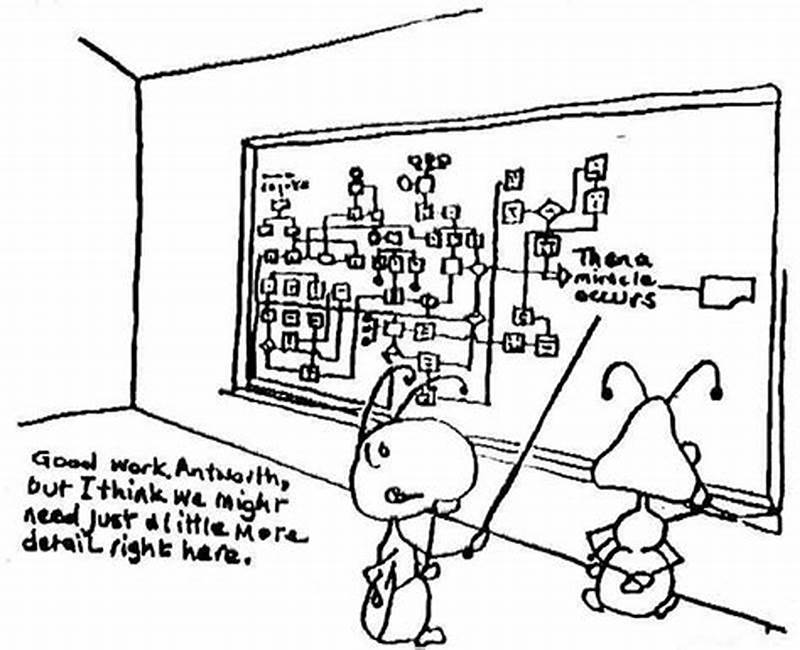
How do you structure a manuscript of 80,000 – 100,000 words? This was the question the Book Length Project Group asked on a warm Sunday morning last month. It reminds me of this picture I stuck on my office wall when I was writing my honours thesis.
Miracles aside, there are lots (and lots and lots) of ways to think about plot and structure. Your favourite search engine will deliver them to you in abundance and the one that is right for you and your manuscript will be… the one that is right for you and your manuscript. Last month we got back to basics and asked ourselves these questions about our own manuscripts:
- What is the initiating event?
- What did it cause to happen?
- What were the consequences?
- Why should a reader care about those consequences?
Simple questions, but hard to answer, as BLPG members found out when we went around the table.
We also grappled with some BLPG member quandaries like What is the word count where I should stop writing? and How (and why) can I change point of view without confusing my readers? and basked in one member’s joy of discovering character-driven plotting.
My completed honours thesis now sits on the shelf of my writing room. The miracle arrived in the form of an established structure for academic writing and some well-applied bum glue. I still use the bum glue, but I’ve replaced the academic discipline with a variety of techniques gleaned from my peers and more suited to modern fiction. If you, like me and the members of the Book Length Project Group, think that you and your project might benefit from some peer support, come and join us!
The Book Length Project Group meets on the third Sunday of every month at Mattie Furphy House in Swanbourne. All FAWWA members and friends are welcome. If you would like to join us, please go to https://www.fawwa.org/event
 Karen Herbert